Mining Employees (United States)
Overview
Mining employment in the United States reflects long‑term shifts in energy demand, mineral production, commodity prices, and technological change. While the mining sector has historically been tied to coal, today’s employment levels also reflect activity in metal ore mining, nonmetallic mineral extraction, and support services for mining operations.
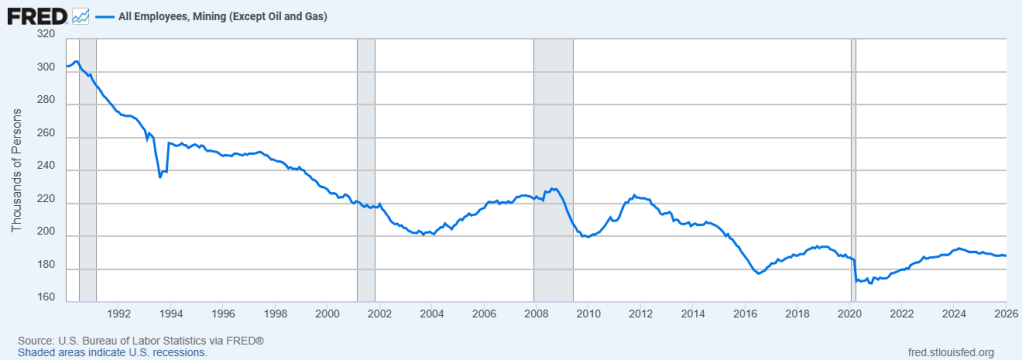
This page uses official labor market data from the U.S. Bureau of Labor Statistics, accessed through the Federal Reserve Bank of St. Louis (FRED), to track national mining employment over time.
Key Insights
- Mining employment has experienced long‑term decline from its historical highs, but remains a critical part of the U.S. industrial base.
- Employment levels fluctuate with:
- Commodity cycles
- Global demand for metals
- Energy transitions
- Technological improvements
- Environmental and regulatory changes
- As of early 2026, national mining employment is roughly 195–200 thousand workers, depending on the month.
- Growth in metal ore mining and nonmetallic mineral extraction has partially offset declines in coal mining.
Why This Indicator Matters
Mining employment is a key measure of:
- Industrial activity
- Resource demand
- Regional economic health in mining‑dependent states
- Labor market shifts within extractive industries
- Energy and commodity cycles
Tracking this data helps illustrate how the U.S. mining sector evolves as global markets and domestic energy policies change.
 commonwealthmining.com