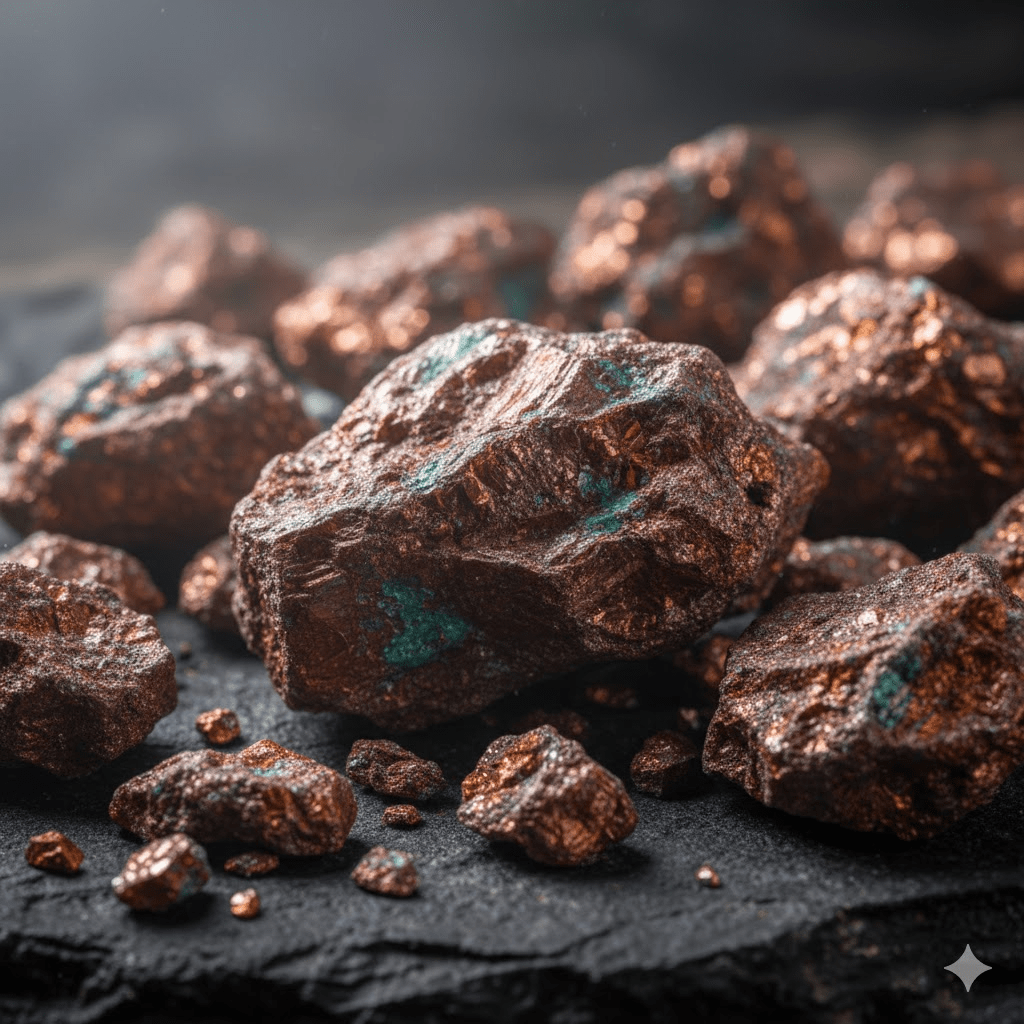
COPPER
Copper is one of the most important industrial metals in the world. Known for its excellent electrical conductivity, corrosion resistance, and versatility, copper plays a critical role in modern infrastructure, technology, and renewable energy systems. From ancient tools to electric vehicles and power grids, copper has been essential to human progress for thousands of years.
What Is Copper?
Copper is a reddish‑brown metallic element valued for its:
- High electrical and thermal conductivity
- Resistance to corrosion
- Malleability and ductility
- Antimicrobial properties
Copper occurs in nature as:
- Native copper (pure metallic form)
- Sulfide minerals (e.g., chalcopyrite, bornite)
- Oxide minerals (e.g., malachite, azurite)
Most modern copper production comes from large sulfide deposits.
How Copper Forms
Copper deposits form through several geological processes:
1. Hydrothermal Activity
Hot, mineral‑rich fluids deposit copper in veins and fractures.
2. Porphyry Systems
Large, low‑grade deposits associated with intrusive igneous rocks. These are the world’s most important copper sources.
3. Sediment‑Hosted Deposits
Copper accumulates in sedimentary layers, often with shale or sandstone.
4. Supergene Enrichment
Weathering processes concentrate copper near the surface, creating high‑grade oxide zones.
How Copper Is Mined
1. Open‑Pit Mining
Most copper is mined from massive open pits due to the size and depth of porphyry deposits.
2. Underground Mining
Used for high‑grade veins or deep deposits.
3. Byproduct Mining
Copper is often produced alongside:
- Gold
- Molybdenum
- Silver
This improves the economics of large mining operations.
Copper Processing Methods
1. Crushing and Grinding
Ore is crushed and ground into fine particles to release copper minerals.
2. Flotation
Chemicals attach to copper minerals, allowing them to float and be separated from waste rock. This produces a copper concentrate.
3. Smelting
Concentrate is heated to remove impurities and produce matte copper.
4. Converting and Refining
Further refining produces blister copper (≈98% pure), then cathode copper (99.99% pure).
5. Heap Leaching (Oxide Ores)
Acid solutions dissolve copper from oxide minerals. The copper is recovered through electrowinning.
Uses of Copper
1. Electrical Systems
Copper is the backbone of modern electricity. Used in:
- Wiring
- Motors
- Transformers
- Power grids
2. Construction
Used for:
- Plumbing
- Roofing
- Heating systems
3. Electronics
Essential for circuit boards and connectors.
4. Renewable Energy
Copper demand is rising due to:
- Solar panels
- Wind turbines
- Electric vehicles
- Battery systems
5. Industrial Machinery
Copper alloys (bronze, brass) are used in tools, bearings, and mechanical components.
Major Copper‑Producing Regions
Top copper‑producing countries include:
- Chile (world’s largest producer)
- Peru
- China
- United States
- Democratic Republic of the Congo
- Australia
Chile’s massive porphyry deposits dominate global supply.
Environmental Considerations
Copper mining requires careful management of:
- Tailings and waste rock
- Water use and treatment
- Acid rock drainage
- Energy consumption
- Land restoration
Modern operations follow strict environmental and safety regulations.
Conclusion
Copper is a vital industrial metal that powers modern technology, infrastructure, and renewable energy systems. Its unique properties and global demand make it one of the most important minerals mined today. Understanding how copper forms, where it is found, and how it is extracted provides valuable insight into the backbone of the world’s electrical and industrial systems.
 commonwealthmining.com