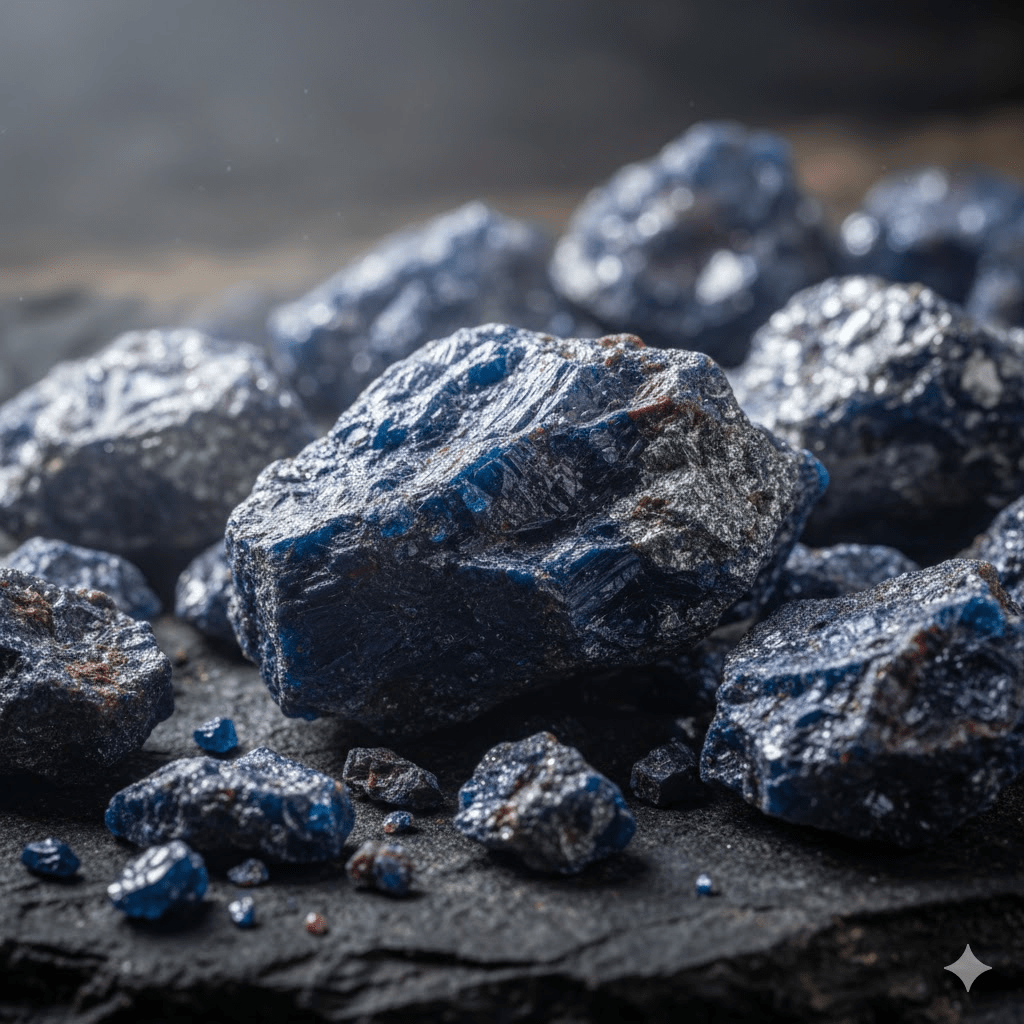
COBALT
Cobalt is a critical mineral essential to modern battery technology, aerospace engineering, and high‑strength alloys. Known for its heat resistance, magnetic properties, and ability to stabilize rechargeable batteries, cobalt has become one of the most strategically important metals in the global energy transition. Its role in electric vehicles and renewable energy storage has driven significant demand worldwide.
What Is Cobalt?
Cobalt is a hard, silver‑gray metallic element valued for its:
- High melting point
- Magnetic properties
- Corrosion resistance
- Ability to form strong, heat‑resistant alloys
Cobalt rarely occurs in pure form. Instead, it is typically found in:
- Sulfide deposits (often with copper and nickel)
- Laterite deposits (weathered ultramafic rocks)
- Byproduct ores from nickel and copper mining
Most cobalt is produced as a byproduct, making its supply closely tied to other metals.
How Cobalt Forms
1. Sediment‑Hosted Copper Deposits
Cobalt often occurs with copper in large sedimentary basins. These deposits are among the world’s most important cobalt sources.
2. Nickel‑Cobalt Laterites
Formed through intense tropical weathering of ultramafic rocks. Cobalt accumulates in limonite and saprolite layers.
3. Magmatic Sulfide Deposits
Cobalt is found with nickel and copper in deep, igneous rock formations.
How Cobalt Is Mined
1. Byproduct Mining (Most Common)
Cobalt is primarily produced as a byproduct of:
- Copper mining
- Nickel mining
This means cobalt production depends heavily on the economics of these metals.
2. Open‑Pit Mining
Used for shallow laterite deposits in tropical regions.
3. Underground Mining
Used for deep copper‑cobalt deposits, especially in Central Africa.
Cobalt Processing Methods
1. Crushing and Grinding
Ore is reduced to fine particles to release cobalt‑bearing minerals.
2. Flotation
Separates cobalt minerals from waste rock, often alongside copper or nickel.
3. Smelting
Produces a mixed matte containing cobalt, nickel, and copper.
4. Hydrometallurgical Processing
Acid leaching dissolves cobalt for purification.
5. Refining
Solvent extraction and electrorefining produce high‑purity cobalt metal or cobalt sulfate.
Cobalt sulfate is especially important for battery manufacturing.
Uses of Cobalt
1. Batteries (Largest Use)
Cobalt improves:
- Battery stability
- Energy density
- Safety
- Longevity
Used in lithium‑ion batteries for:
- Electric vehicles
- Smartphones
- Laptops
- Energy storage systems
2. Superalloys
Cobalt‑based alloys withstand extreme heat and stress. Used in:
- Jet engines
- Gas turbines
- Aerospace components
3. Hard Metals and Tools
Cobalt strengthens cutting tools and wear‑resistant materials.
4. Magnets
Cobalt is used in high‑performance permanent magnets.
5. Medical and Industrial Applications
Cobalt‑60 is used in:
- Cancer treatment
- Sterilization
- Industrial radiography
Major Cobalt‑Producing Regions
1. Democratic Republic of the Congo (DRC)
Produces over half of the world’s cobalt, primarily from copper‑cobalt deposits.
2. Indonesia
Rapidly growing producer from nickel laterite operations.
3. Australia
Significant nickel‑cobalt resources.
4. Russia
Produces cobalt from nickel sulfide deposits.
5. Canada
Long history of nickel‑cobalt mining.
Environmental and Ethical Considerations
1. Artisanal Mining Concerns
In some regions, artisanal mining raises issues related to:
- Worker safety
- Child labor
- Informal mining practices
2. Waste and Tailings
Cobalt extraction produces significant waste materials requiring careful management.
3. Water and Chemical Use
Processing often involves acids and requires responsible water treatment.
4. Sustainability Challenges
Growing demand has increased focus on:
- Battery recycling
- Ethical sourcing
- Reducing cobalt content in batteries
- Developing alternative chemistries
Conclusion
Cobalt is a vital mineral powering modern technology, especially rechargeable batteries and high‑performance alloys. Its unique properties make it essential for electric vehicles, aerospace engineering, and renewable energy systems. As global demand increases, responsible sourcing, recycling, and technological innovation will shape the future of cobalt production.
 commonwealthmining.com