Coal Mining Employees (United States)
Overview
Coal mining employment in the United States has undergone significant long‑term change, reflecting shifts in energy demand, technological improvements, environmental regulations, and global market conditions. Employment levels in the coal sector have declined substantially from their historical peaks, but the industry continues to play a role in regional economies, particularly in Appalachia and parts of the West.
This page provides a clear, data‑driven look at coal mining employment using official labor market data from the U.S. Bureau of Labor Statistics, accessed through the Federal Reserve Bank of St. Louis (FRED).
Key Insights
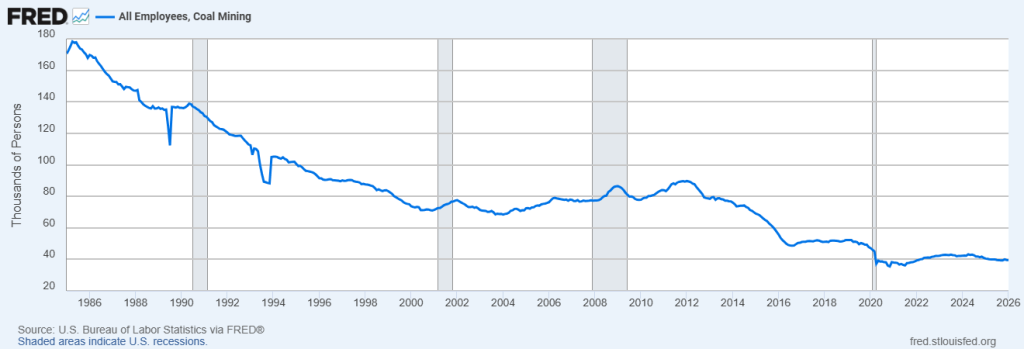
- Coal mining employment has fallen dramatically from its peak in the 1980s, when more than 150,000 workers were employed in the sector.
- As of early 2026, employment stands around 39–40 thousand workers, reflecting long‑term structural decline.
- Automation, natural gas competition, renewable energy growth, and environmental regulations have all contributed to reduced labor demand.
- Despite the decline, coal mining remains a major employer in certain regions, supporting local economies and related industries.
Why Employment Matters
Coal mining employment is a key indicator of:
- Regional economic health in coal‑dependent communities
- Energy sector transitions
- Labor market shifts within extractive industries
- Policy impacts on traditional energy sectors
Tracking employment helps illustrate how the U.S. energy landscape is evolving and how workers are affected by long‑term structural changes.
 commonwealthmining.com