Average Hourly Earnings of Production Employees
Overview
Average hourly earnings in the mining and logging sector provide a clear view of wage trends for production and nonsupervisory employees — the workers directly involved in extraction, processing, and on‑site operations. These wages reflect labor demand, commodity cycles, productivity changes, and broader economic conditions.
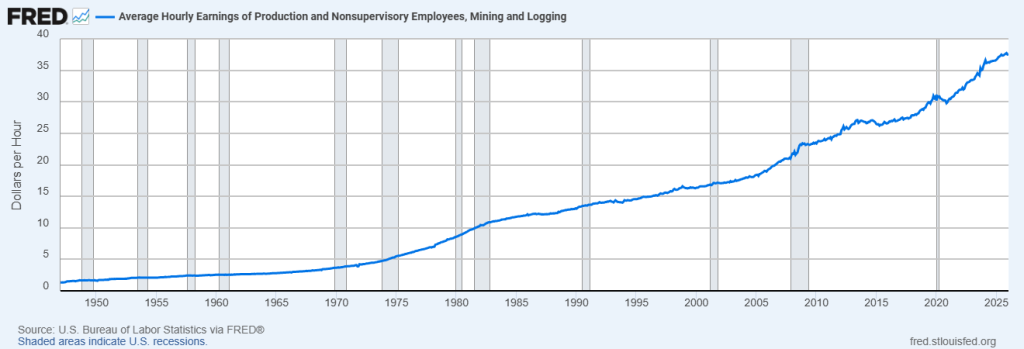
This page uses official U.S. Bureau of Labor Statistics data accessed through the Federal Reserve Bank of St. Louis (FRED). The series tracks wage levels from 1947 to the present, offering one of the longest continuous labor‑market datasets available for the natural resources sector.
Key Insights
- As of January 2026, production employees in mining & logging earn an average of $37.53 per hour, one of the highest wage levels among goods‑producing industries.
- Wages have steadily increased over the past decade, reflecting:
- Higher skill requirements
- Increased safety and compliance standards
- Tight labor markets in resource‑dependent regions
- Commodity‑driven demand cycles
- Long‑term data (1947–2026) shows a consistent upward trend, with wages rising significantly faster than many other sectors.
- Wage spikes often align with periods of strong commodity prices (coal, metals, aggregates).
Why This Indicator Matters
Average hourly earnings help illustrate:
- Labor market strength in mining & logging
- Cost pressures for mining companies
- Worker compensation trends in extractive industries
- Economic health of resource‑dependent regions
- Inflation and productivity dynamics within the sector
Because production employees represent the operational core of mining and logging, their wage trends are a strong indicator of industry conditions.
 commonwealthmining.com